
Island resort decarbonisation & enhanced energy independence through PV & BESS integration
Island resorts sit at the sharp end of the energy transition: grid connection is not an option, diesel must be shipped in by sea, and every litre burned adds cost, emissions and supply vulnerability. The hybrid microgrid commissioned at Taj Coral Reef Resort in the Maldives, delivered by Swimsol, the expert in floating solar PV systems and island microgrids installations, and ComAp, the global supplier of smart control solutions, shows a practical route away from that dependence.
The site parallels three sources on a single off-grid island grid: three diesel gen-sets, 1,058.4 kWp solar array, and 810 kW / 1,223 kWh of battery storage. Rather than running solar and storage as a supplement to the diesel gensets, the system inverts the usual hierarchy; PV and battery act as the primary sources, with gen-sets called on only when renewable generation and storage cannot cover the demand. The battery’s inverters provide virtual synchronous generator (VSG) capability, a necessary component for letting it form and stabilise the grid on its own. Without that feature, this role would be traditionally reserved for rotating diesel plant.
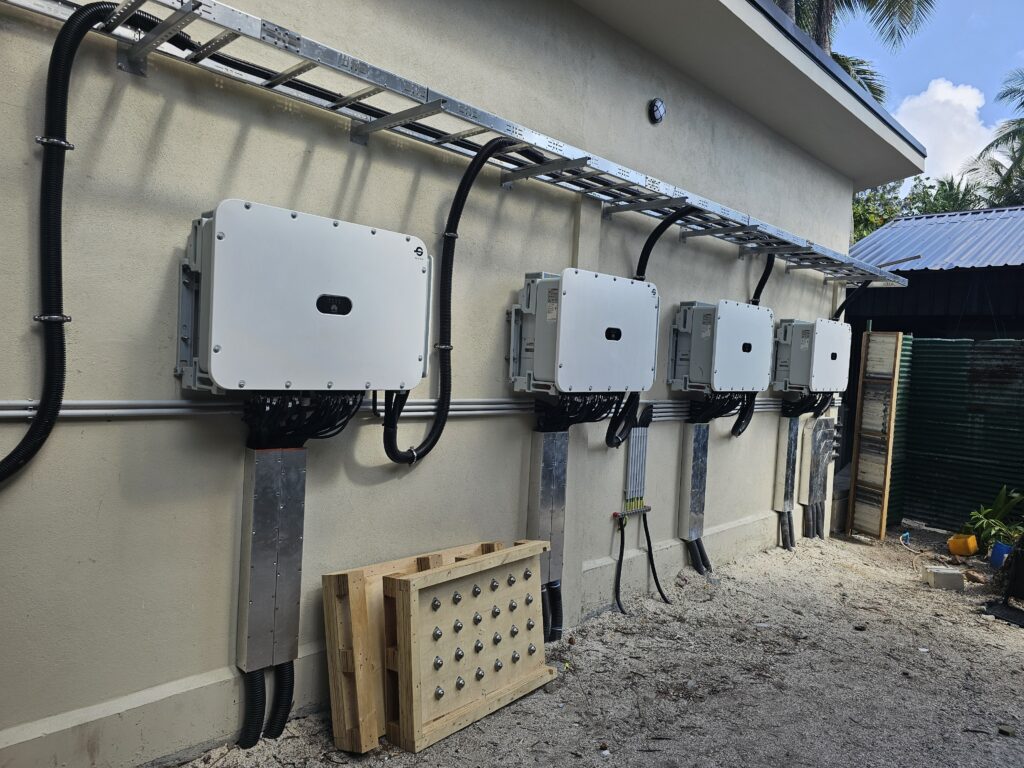
Underpinning that renewable-first operation is a coordination layer of three gen-set controllers, one microgrid controller, six BESS controllers which set up the VSG mode on the PCS (Power Conversion System) of the BESS pack, and four displays, commissioned by ComAp on site and supported remotely since go-live.
The result is a significant cut in the fuel consumption alongside a stable and reliable supply — the two main objectives that typically pull in opposite directions on off-grid islands, where reliability has historically meant more diesel capacity, not less. For Swimsol, the major factor is not a single component control, but rather the components integration and overall management – bringing gen-sets, PV inverters and battery storage under one control system, with scope for further roll-out across similar island sites.
For the wider industry, the project is a useful data point in an ongoing discussion: how far battery-led, grid-forming control can substitute for diesel as the anchor of an isolated microgrid, and at what point storage sizing and control sophistication — rather than solar capacity alone — become the binding constraint on energy independence for remote island communities.